Brain-Changing Strategies to Trauma-Proof Our Schools by Maggie Kline
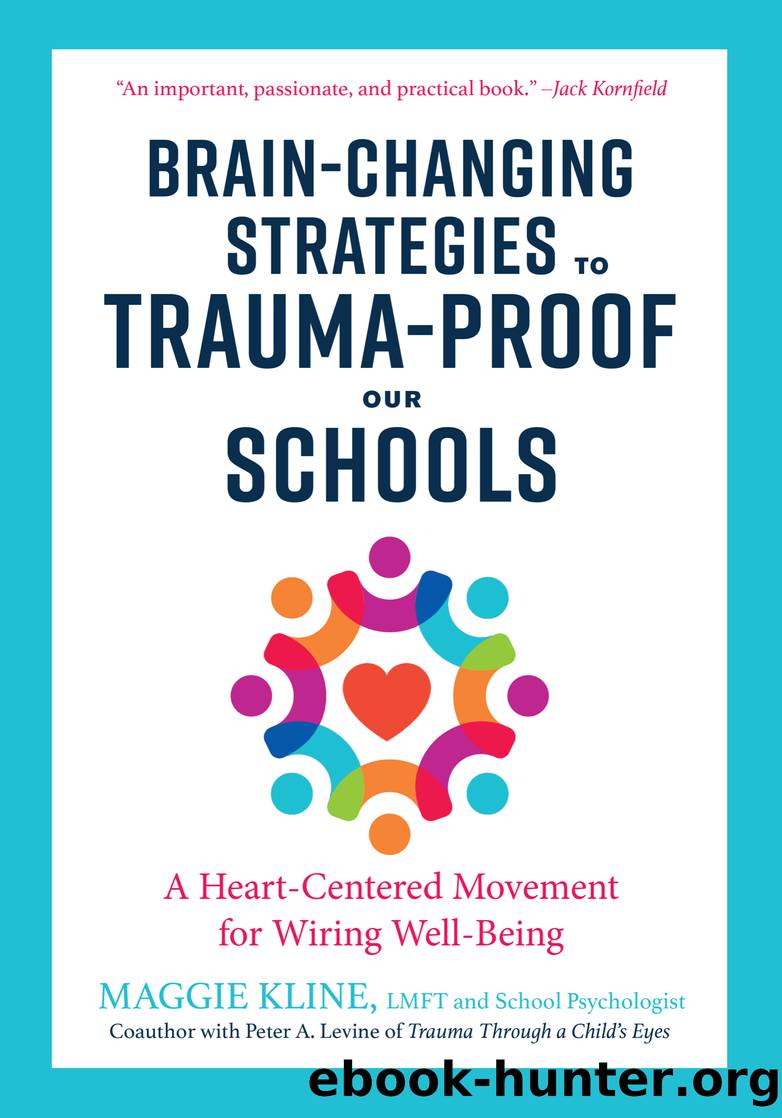
Author:Maggie Kline [Kline, Maggie]
Language: eng
Format: epub
ISBN: 9781623173272
Publisher: North Atlantic Books
Because the struggle for educators to find the best practices in handling aggressive students at school is such a pervasive topic, chapter 6 is devoted to ways of working with volatile youngsters that provide enduring solutions, transforming them from the inside out. In far too many cases, perhaps the majority of cases, violence is the result of unresolved trauma leading to a deficit in self-regulation. You will learn de-escalation and adult-guided âassisted self-regulationâ activities for your most challenging children. However, exercises are included that will benefit the whole class by promoting optimal mental and physical health, as well as creating a safer environment.
We know that trauma plays a key role in your studentsâ conduct, whether it is acting âoutâ or acting âin.â We also know that trauma combined with other contributing factors, such as poverty and lack of parental involvement or emotional unavailability, is a recipe for a variety of disturbances in conduct. Violence in the media and video games also contribute to the shaping of our childrenâs behavior. The first step is to recognize what trauma âlooks likeâ in your students. One way is to review chapter 1. Another way is to use homeroom, science, or health class to have students anonymously take a self-administered ACEs screening and only volunteer their score, without disclosing private information unless they wish to share with someone they trust to help. (See appendix A for ACEs Questionnaire.)
The next step is to become proficient in working with the dynamics of autonomic nervous system cycles of charge and discharge by tracking the sensations both in yourself and in your students. Once you are grounded in these skills, it will be fairly easy to use the activities described in this chapter and to adapt activities you may already be using to help all children grow toward sustainable self-regulation. In the effective twenty-first-century classroom, application of the biologically-based behavioral interventions offered here is critical in providing the keys to success. Now letâs look at how I harnessed the neuroscience of trauma to assist James.
Jamesâs Story of Escalating Violent Behavior at School and at Home
James was adopted from a Thailand orphanage when he was five years old. Although he was sharp, adjusted easily to his new language and culture, and was happy with his adoptive family, his parents shared that James became increasingly difficult to manage as he got older. He would become irritated, aggressive, and verbally defiant when limits were set at school or by his mother. Both parents were warm and caring, but only his mother was the disciplinarian; while his father was active with recreational activities with James, he had a more permissive parenting style when it came to rules. By the time his teenage hormones set in, Jamesâs aggression turned to increasingly violent behavior. It was reported that he had incidents of physical fights at school and shoving his mother so hard against a closet door that it frightened and injured her.
When I met with James for the first time, I offered to help him with his violent outbursts if he was willing to work with me.
Download
This site does not store any files on its server. We only index and link to content provided by other sites. Please contact the content providers to delete copyright contents if any and email us, we'll remove relevant links or contents immediately.
The Art of Coaching Workbook by Elena Aguilar(51102)
Trainspotting by Irvine Welsh(21587)
Twilight of the Idols With the Antichrist and Ecce Homo by Friedrich Nietzsche(18588)
Fangirl by Rainbow Rowell(9197)
Periodization Training for Sports by Tudor Bompa(8228)
Change Your Questions, Change Your Life by Marilee Adams(7701)
This Is How You Lose Her by Junot Diaz(6848)
Asking the Right Questions: A Guide to Critical Thinking by M. Neil Browne & Stuart M. Keeley(5723)
Grit by Angela Duckworth(5561)
Red Sparrow by Jason Matthews(5436)
Paper Towns by Green John(5149)
Room 212 by Kate Stewart(5079)
Ken Follett - World without end by Ken Follett(4694)
Housekeeping by Marilynne Robinson(4410)
The Sports Rules Book by Human Kinetics(4356)
Double Down (Diary of a Wimpy Kid Book 11) by Jeff Kinney(4247)
Papillon (English) by Henri Charrière(4232)
The Motorcycle Diaries by Ernesto Che Guevara(4059)
Exercise Technique Manual for Resistance Training by National Strength & Conditioning Association(4039)
